Your teeth do far more than help you smile – each one is a small, surprisingly complex structure built to handle a lifetime of biting and chewing. Understanding the basic anatomy of a tooth makes it much easier to look after your teeth and to understand what your dentist is talking about. Here is a clear guide to the parts of a tooth and what each one does.
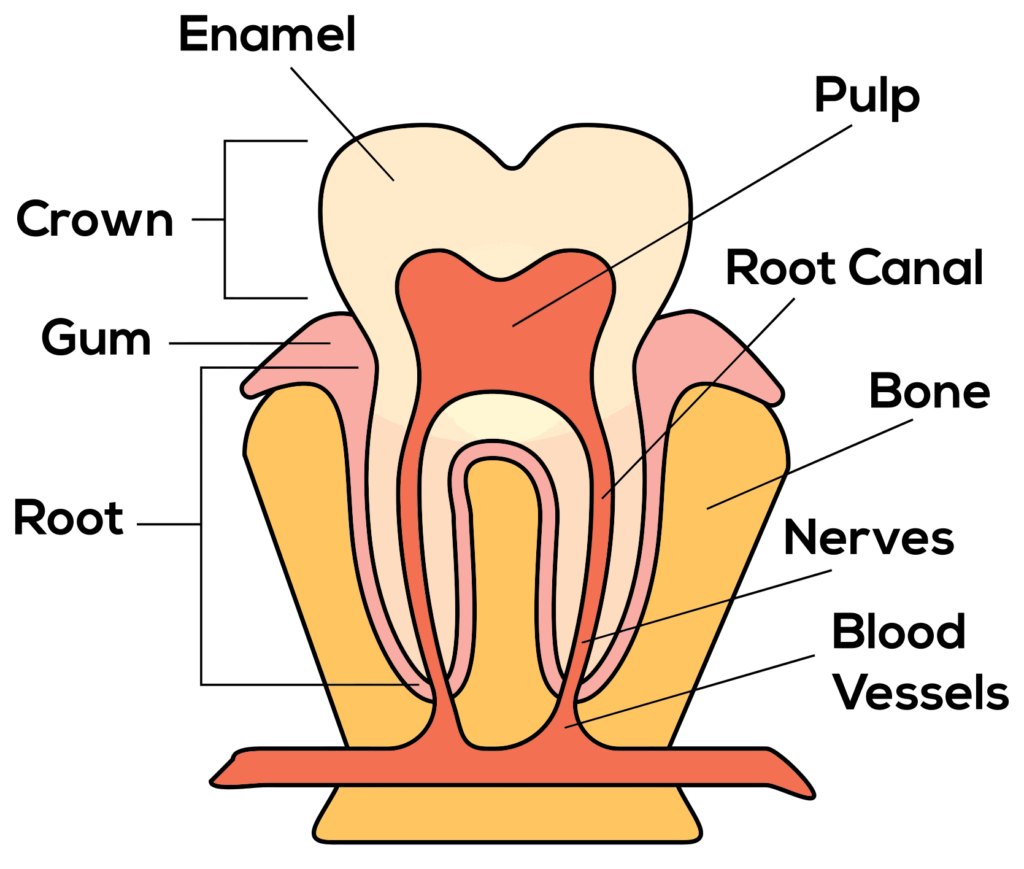
Every tooth has two regions: the crown, which is the part you can see above the gum, and the root, which anchors the tooth into the jawbone beneath the gum. In a healthy mouth, roughly a third of the tooth is visible, while the rest is below the surface holding everything firmly in place.
The roots are the foundations of your teeth. They sit in sockets in the jawbone and are held in place by a network of tiny fibres called the periodontal ligament, which cushions the tooth against the forces of chewing. Front teeth usually have a single root, while the larger back teeth – the molars – often have two or three roots to cope with the heavier load of grinding food. Healthy roots, and the bone around them, are essential to keeping teeth stable for life, which is why gum health matters so much.
The nerve sits within the pulp at the centre of the tooth. Its main job is to act as a warning system: it lets you feel temperature, pressure and pain, alerting you to problems such as decay, a crack or infection before they become serious. The nerve also supplies the developing tooth as it forms. Interestingly, a fully grown tooth can survive without its nerve – which is exactly what happens after root canal treatment, when an infected nerve is removed but the tooth itself is saved.
The back surfaces of your teeth – and the back teeth themselves – are among the most commonly neglected areas when brushing. The inside surfaces of the lower front teeth are a favourite spot for tartar, and the chewing surfaces of the molars have grooves that trap food and plaque. Angling your brush to reach behind your front teeth, and taking the time to clean the molars thoroughly, makes a real difference to your long-term dental health.
Healthy teeth depend on looking after all of these structures – the enamel on the surface, the gums and bone around the roots, and the nerve at the core. The best protection is simple: brush twice a day, clean between your teeth daily, and visit us regularly so any problems are caught early.
For more on how your teeth are built, see our tooth anatomy FAQ, or call Heathwood Dental Practice in Crowthorne on 01344 776933 to book a check-up.

Fill in the form and our friendly team will be in touch with you momentarily.
I have been at Heathwood Dental Practice for around 4 years. I have to say everyone at Heathwood Dental Practice is superb. Kerry, Helen & Charlene are superb at reception and ring me to see if I’m ... Read More
I just completed a course of corrective dentistry using Smilelign from Heathwood. The whole procedure from start to finish was brilliant. Vishal provided a 1st rate assesment and guidance throughout t... Read More
I had a new to me local anaesthetic technique that was painless and didn’t leave me with any numbness in my mouth. And the tooth repair was amazing too. It was all very easy and relaxing. Thank you ... Read More
Heathwood Dental is a fantastic dental practice. Dr Vishal Kumar is very knowledgeable, highly skilled and always takes the time to talk through any proposed treatment and particular techniques/materi... Read More
Never my favourite place to be but the experience was made much less painful by the lovely service I received. A professional hygienist who gave great advice and expert treatment. Would highly recomme... Read More
