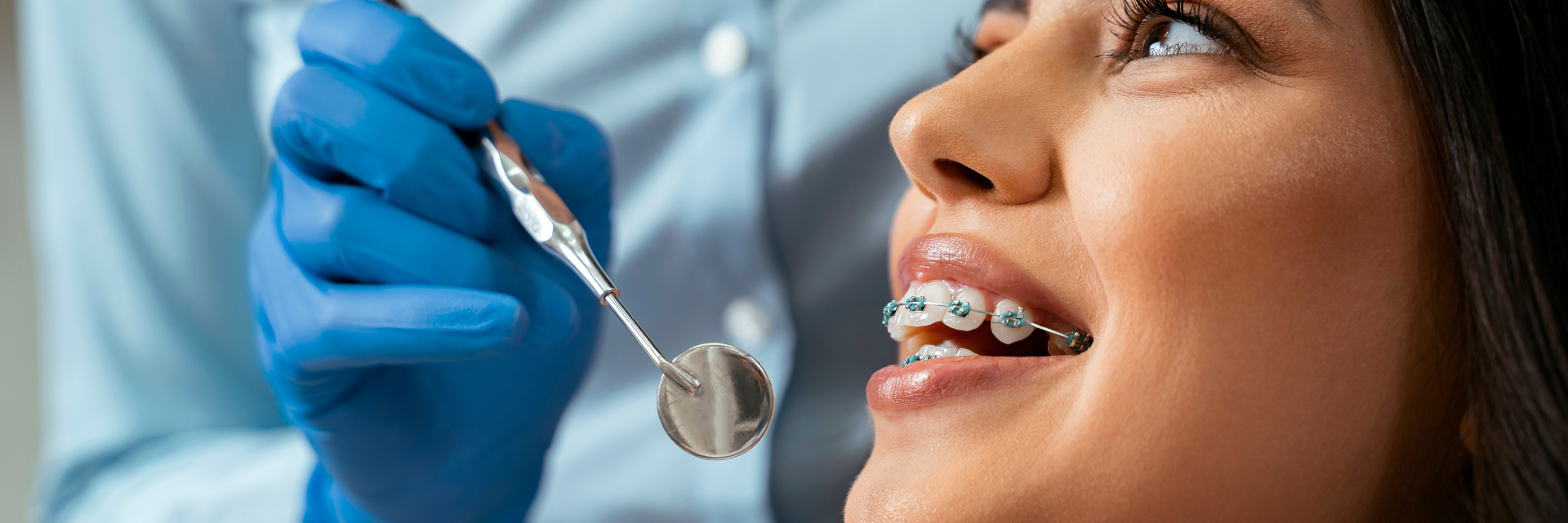
Orthodontics is the teeth-straightening speciality. Although teeth are held stationary in the bone, they can be moved with small constant forces; this is how braces work. However, it is not only braces that can move teeth. Any constant force can do this, with the most common causes that we see being use of a dummy or thumb sucking in children. This, for example, causes a narrower palate to develop, resulting in a more crowded and narrow upper arch, with the teeth becoming overlapped, and failing to meet properly.
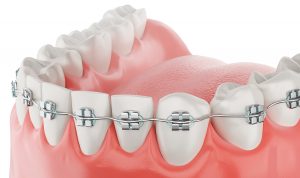
There are many reasons for pursuing orthodontic treatment, including:
Orthodontic treatment is commonly initiated in children once all the adult teeth have erupted, and we can arrange referral to an orthodontic specialist at the appropriate time. In children, the timing is important, as facial growth can often be harnessed to adjust the facial contours and correct issues such as a narrow palate. In addition, children’s bone is softer, meaning that teeth usually move faster, resulting in shorter treatment times.
Orthodontics is not limited to children. An increasing number of adults are taking advantage of modern dentistry to improve their smiles.
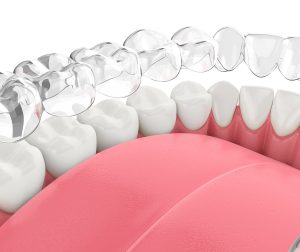
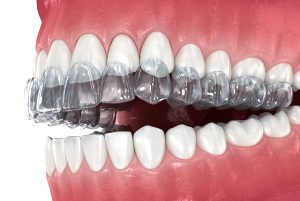
It is critical to understand that the long-term success of all orthodontics, whether in children or adults, is linked to the use of retainers. These are issued at the end of orthodontic treatment and need to be worn, typically at night long-term, to prevent the teeth from drifting out of place. They are usually clear, and look like the retainer in the Invisalign picture below.
As the name suggests, these can be taken out of the mouth, so good compliance is required from the patient. They are used typically to tilt teeth, although there are also appliances used to modify the growth of the jawbones. Occasionally at the end of treatment, the retainers may be made in this format.
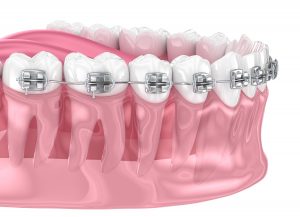
These are the most commonly used orthodontic appliances, and are very effective, as they can be used to move a whole tooth through the bone, rather than just tip it as with removable appliances.
Invisalign is the most established clear aligner system. It involves a series of virtually invisible clear trays that fit over the teeth.
These are critical for long-term stability after treatment.
Treatment duration varies but typically lasts 6 months to 2 years, depending on the complexity of the case.
Clear aligners work well for mild to moderate cases, while fixed braces are better for complex movements.
Mild discomfort is common after adjustments, but it is manageable with over-the-counter pain relief.
Yes! Orthodontics is suitable for patients of all ages, with many discreet options available for adults.
Yes, retainers are essential to maintain your new smile and prevent teeth from shifting back.

Fill in the form and our friendly team will be in touch with you momentarily
I just completed a course of corrective dentistry using Smilelign from Heathwood. The whole procedure from start to finish was brilliant. Vishal provided a 1st rate assesment and guidance throughout t… Read More
I had a new to me local anaesthetic technique that was painless and didn’t leave me with any numbness in my mouth. And the tooth repair was amazing too. It was all very easy and relaxing. Thank you … Read More
Heathwood Dental is a fantastic dental practice. Dr Vishal Kumar is very knowledgeable, highly skilled and always takes the time to talk through any proposed treatment and particular techniques/materi… Read More
Never my favourite place to be but the experience was made much less painful by the lovely service I received. A professional hygienist who gave great advice and expert treatment. Would highly recomme… Read More
I’m one step closer to my brand new tooth, despite being MANY years past the age of new teeth. Thanks to Neena and Mariska at Heathwood Dental I had a smooth, pain free, easy impant of the ‘socket’ in… Read More
