Understanding basic tooth anatomy makes it much easier to look after your teeth. Each tooth has a crown — the part you can see above the gum — and one or more tooth roots that anchor it firmly into the jawbone beneath the gum. Healthy teeth roots, the bone around them and the nerve at the centre of the tooth (which is removed during root canal treatment if it becomes infected) all need to stay healthy for a tooth to last a lifetime. Below we explain the main parts of a tooth and what each one does.
Teeth can be broadly divided into the part visible above the gum, the ‘crown’, and the ‘root’ which is buried in bone, under the gum. The bone holds the tooth in place.
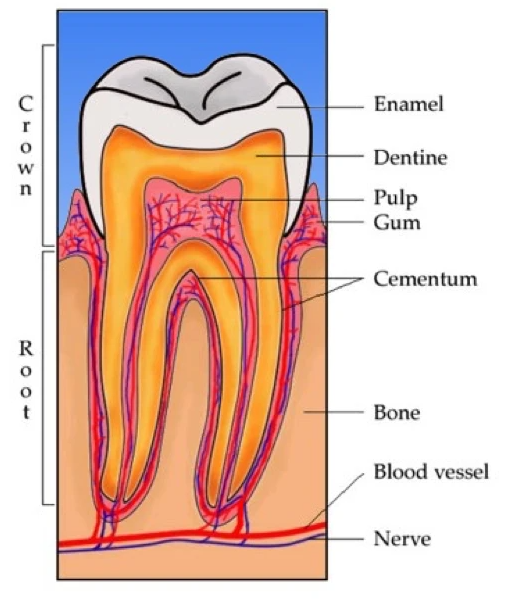
The outer layer of the crown is composed of Enamel. This whitish translucent layer is the hardest substance in the body. It is thickest on the biting surface of the tooth, and thinnest at the sides, especially near the gum edge.
Supporting the enamel, and also composing the root of the tooth is Dentine. This yellowish porous material is softer than enamel, and is perforated by many microscopic channels. Within some of these are nerve fibres, which give dentine a certain amount of sensitivity, allowing us to detect problems such as decay. When gum recession occurs, such that the dentine of the root is exposed in the mouth, these areas can become sensitive., especially but not exclusively to temperature changes (for example, hot and cold drinks).
Within the centre of each tooth, enclosed by dentine, is contained a collection of nerves and blood vessels, collectively known as the pulp. The pulp connects to the main nerves and blood vessels of the jaws through the tip of each root.
Common problems that we encounter with teeth are: