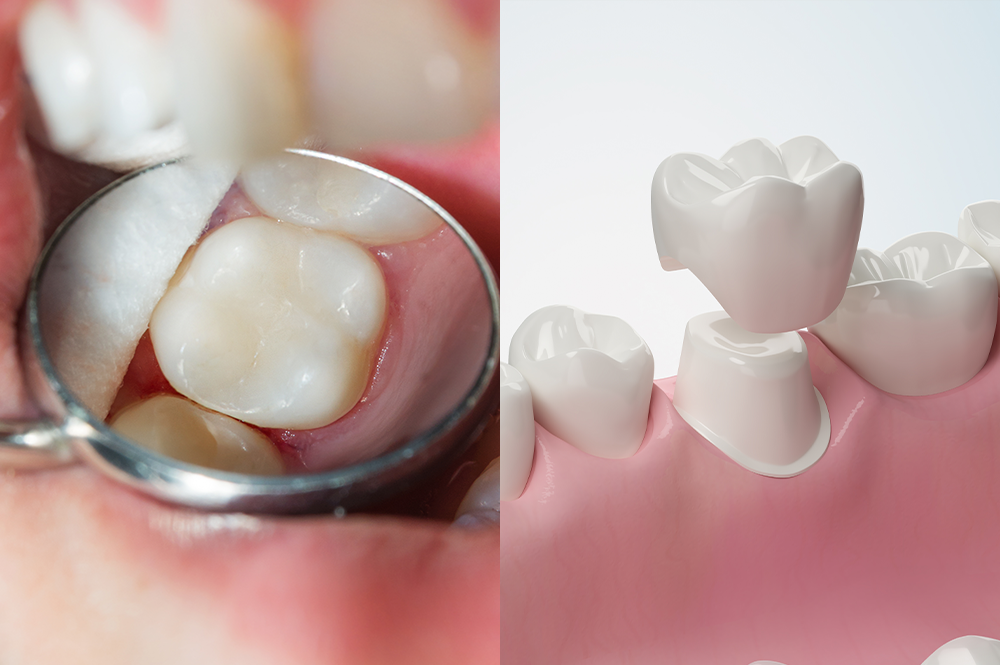
If you have a cracked tooth, a failing filling, or have been told you need a crown, you may be wondering whether there is a better alternative. Biomimetic dentistry is a growing approach in the UK that is changing the way many dentists restore damaged teeth and the results are impressive. In this post, our team at Heathwood Dental Practice in Crowthorne explains exactly what biomimetic dentistry is, how it compares to conventional treatment, and whether it might be the right choice for your tooth.
What Does “Biomimetic” Actually Mean?
The term biomimetic comes from the Greek bio, meaning life, and mimesis meaning to imitate. In dentistry, it describes a method of restoring teeth that replicates the natural properties of enamel and dentine, the two main layers a healthy tooth is made of.
Rather than simply filling a hole or covering a tooth with a crown, biomimetic dentistry rebuilds the tooth layer by layer, using materials that behave like the real thing flexing under bite pressure, bonding tightly to the remaining tooth, and sealing out bacteria.
The Problem with Large Fillings — Why They Fail
Most people have had a filling at some point. Small fillings in healthy teeth can last well. But large fillings particularly those replacing a significant portion of the tooth have a known weakness.
A tooth is not a rigid block. When you bite, it flexes ever so slightly. This flexion distributes bite forces evenly across the tooth, preventing cracks. A large conventional filling does not flex in the same way. The result is a mismatch in movement between the filling and the tooth wall around it, creating tiny stress points with every bite. Over months and years, hairline cracks develop in the tooth structure, and one day often whilst eating something completely ordinary part of the tooth breaks.
This is not bad luck. It is a predictable mechanical failure, and it is exactly what biomimetic dentistry is designed to prevent.
Why Crowns Are Not Always the Answer
A dental crown is often presented as the gold standard solution for a cracked or heavily filled tooth. And in some cases, it genuinely is the right choice. But there is a significant downside that is rarely discussed openly: to fit a crown, a dentist must grind away a large portion of your remaining natural tooth typically between 60 and 75 percent of the visible structure to create a shape the crown can sit over.
That is a lot of healthy tooth to sacrifice. And once removed, that structure is gone permanently.
There is also a longer-term risk. Studies have shown that crowned teeth have a higher rate of eventually needing root canal treatment, because the preparation process brings the drill close to the nerve. A tooth that has had a crown, and then needs root canal treatment, and then the crown fails, is a tooth that is heading towards extraction. This is the destructive restorative cycle that biomimetic dentistry specifically aims to break.
How Biomimetic Dentistry Works Differently
Instead of grinding away healthy tooth to make room for a restoration, biomimetic dentistry takes an additive approach. Using advanced adhesive bonding and high-quality composite materials, the dentist carefully removes only what is damaged, then rebuilds the tooth in layers from the inside out.
Each layer is designed to replicate a specific property of natural tooth structure. The deeper layers mimic dentine flexible enough to absorb stress. The outer layers mimic enamel hard enough to withstand wear. The result is a restoration that bonds chemically to the tooth, moves with it naturally, seals the nerve away from bacteria and temperature, and distributes bite forces just as nature intended.
For more extensively damaged teeth, a bonded ceramic onlay can be used over the biting surface — delivering crown-like protection without removing nearly as much of the healthy underlying tooth.
Can Biomimetic Dentistry Save a Tooth That Would Otherwise Need a Crown?
In many cases, yes. This is one of the most common questions our patients at Heathwood ask, and the answer is often encouraging.
If a tooth has been identified as needing a crown purely because of the size of an existing failing filling, or because of a crack that has been caught at the right stage, a biomimetic restoration can frequently achieve the same outcome a strong, sealed, functional tooth without the irreversible removal of healthy structure.
Even patients who have been told by another dentist that a tooth needs extracting have been surprised to learn that a biomimetic approach could save it. If you are in this position, it is always worth getting a second opinion before committing to extraction.
What About Root Canal Treatment — Can Biomimetic Dentistry Help?
Root canal treatment becomes necessary when bacteria reach the nerve inside the tooth, usually because of deep decay, a cracked tooth that has not been properly sealed, or repeated drilling that has gradually moved the restoration closer and closer to the pulp.
Biomimetic restorations are sealed extremely thoroughly at every margin and layer. This makes it much harder for bacteria to penetrate through to the nerve, and significantly reduces the thermal and mechanical stress placed on the pulp during and after treatment. Clinical evidence and long-term case data consistently show that biomimetic restorations are associated with a substantially lower rate of teeth subsequently needing root canal treatment, compared to teeth restored with conventional large fillings or crowns.
Is Biomimetic Dentistry Worth the Cost?
This is a fair question. Biomimetic treatment typically takes longer than a standard filling, requires premium materials, and demands a higher level of technical skill and precision. As a result, the fee is usually higher than a conventional restoration.
However, the relevant comparison is not just the cost today versus a filling today. It is the cost over the lifetime of the tooth. A biomimetic restoration that lasts twenty years and keeps the tooth out of the crown-root canal-extraction cycle is almost certainly less expensive in the long run than a cheaper filling that fails in five years, leads to a crown, then root canal treatment, and ultimately a dental implant or bridge.
Looked at that way, biomimetic dentistry is not a premium option it is the economically rational one.
Finding a Biomimetic Dentist in Berkshire
Biomimetic dentistry requires specific training in adhesive techniques, material science, and smile reconstruction. Not every practice offers it, and the quality of treatment can vary significantly depending on the dentist’s experience and the materials and technology used.
At Heathwood Dental Practice in Crowthorne, Dr Vishal Kumar has completed the prestigious Ab Initio Continuum course in adhesive and minimally invasive dentistry and has trained with world-leading experts in this field. Biomimetic thinking is built into how we approach every restoration at our practice not just the complex cases.
We welcome patients from across Berkshire, including Bracknell, Sandhurst, Wokingham, Camberley, Ascot and Fleet, as well as from further afield for this specialist approach.
Ready to Find Out Whether Biomimetic Dentistry Is Right for You?
If you have a cracked tooth, a failing filling, or have been advised to consider a crown or extraction, please do come and talk to us before making a decision. We are happy to offer honest, second opinions and to talk you through all your options without any pressure.
Call Heathwood Dental Practice on 01344 776933, or book your consultation. Our practice is located at 1 Kings Road, Crowthorne, Berkshire, RG45 7BF.

Fill in the form and our friendly team will be in touch with you momentarily.
Heathwood Dental is a fantastic dental practice. Dr Vishal Kumar is very knowledgeable, highly skilled and always takes the time to talk through any proposed treatment and particular techniques/materi... Read More
I'm one step closer to my brand new tooth, despite being MANY years past the age of new teeth. Thanks to Neena and Mariska at Heathwood Dental I had a smooth, pain free, easy impant of the 'socket' in... Read More
I transferred to the Kings Road site when Vishal took over Heathwood Dental Practice from Dr Smith in 2005, it formerly being located in Ellis Road. Moving from a known dentist to someone new has alwa... Read More
Absolutely first rate service. Incredible expertise and use the latest techniques and materials. I travel nearly an hour to go here as it's by far, the best practise I have ever been to by a considera... Read More
I cannot praise Heathwood Dental practice enough. All staff are extremely easy to deal with and pleasant. I have been treated for many years by Dr. Vishal Kumar and would recommend him to anyone. He i... Read More
