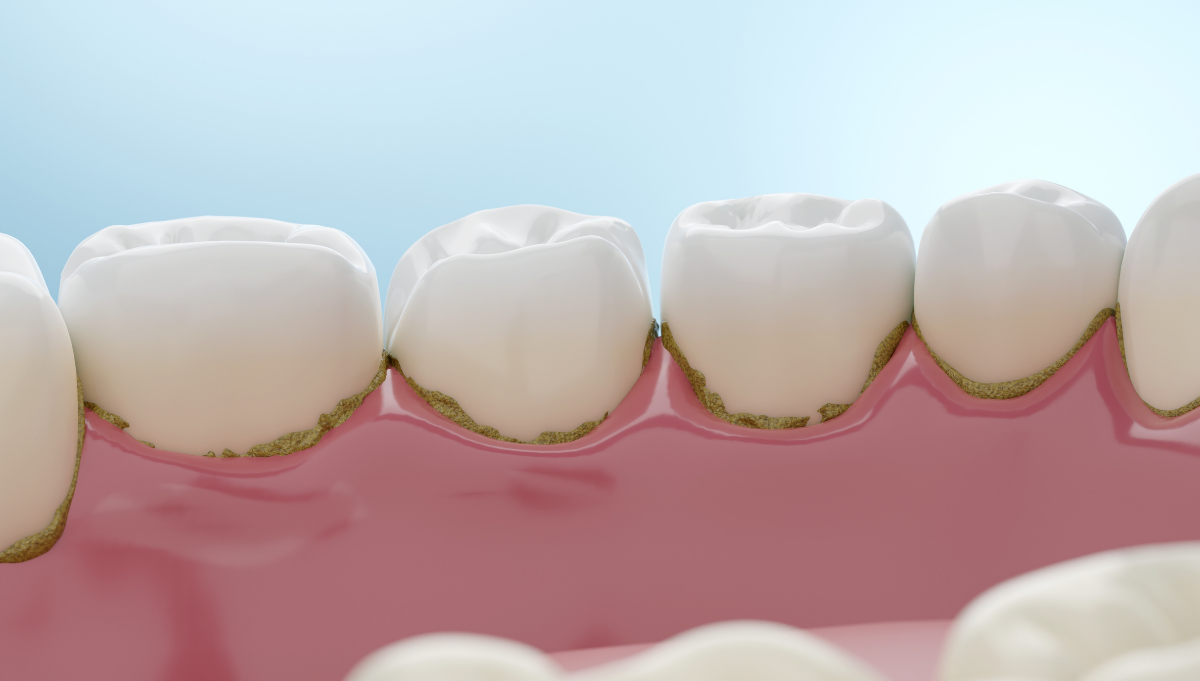
If your dentist or hygienist has mentioned “calculus” or “tartar”, you may be wondering exactly what it is and why it matters. Dental calculus is more than a cosmetic nuisance – it plays a direct role in gum disease and tooth loss. Here is a plain-English guide to what calculus is, how it forms, and the best ways to keep it under control.
Dental calculus, commonly called tartar, is hardened dental plaque. Plaque is the soft, sticky film of bacteria that constantly forms on your teeth. If it is not removed by brushing and flossing, minerals from your saliva gradually harden it – a process sometimes described as the plaque “calcifying” on the teeth. Within a day or two it sets into calculus, a rough, crusty deposit that is firmly stuck to the tooth.
(If you have searched for “callus on teeth”, calculus is almost certainly the term you are after – a callus refers to hardened skin, while calculus is the hardened deposit on teeth.)
Calculus tends to collect in the places that are hardest to clean: along the gum line, between the teeth, and on the inside surfaces of the lower front teeth, which sit near salivary glands. It can form both above the gum line, where it looks yellow or brown, and below it, where it is hidden but more damaging.
Unlike soft plaque, calculus cannot be brushed away once it has hardened – and its rough surface gives even more plaque a place to cling. This matters because:
Once plaque has hardened into calculus, only a dental professional can remove it safely. During a hygiene appointment we use specialised instruments and ultrasonic scalers to lift the deposits away from the tooth and below the gum line, without harming the enamel. Many patients also benefit from Airflow polishing, which uses a jet of fine powder and water to remove staining and lighter deposits comfortably. The result is a properly clean, smooth tooth surface that feels noticeably fresher.
You cannot stop plaque forming, but you can stop it hardening into calculus by removing it daily:
Regular professional cleaning is the most reliable way to stay ahead of calculus and protect your gums. To learn more, see our plaque and calculus FAQ, or call Heathwood Dental Practice on 01344 776933 to book a hygiene appointment.

Fill in the form and our friendly team will be in touch with you momentarily.
I have been at Heathwood Dental Practice for around 4 years. I have to say everyone at Heathwood Dental Practice is superb. Kerry, Helen & Charlene are superb at reception and ring me to see if I’m ... Read More
I just completed a course of corrective dentistry using Smilelign from Heathwood. The whole procedure from start to finish was brilliant. Vishal provided a 1st rate assesment and guidance throughout t... Read More
I had a new to me local anaesthetic technique that was painless and didn’t leave me with any numbness in my mouth. And the tooth repair was amazing too. It was all very easy and relaxing. Thank you ... Read More
Heathwood Dental is a fantastic dental practice. Dr Vishal Kumar is very knowledgeable, highly skilled and always takes the time to talk through any proposed treatment and particular techniques/materi... Read More
Never my favourite place to be but the experience was made much less painful by the lovely service I received. A professional hygienist who gave great advice and expert treatment. Would highly recomme... Read More
